
Why Architects Keep Coming Back to Triangles: The Shape That Builds the Future
- 3 min read
- February 18, 2026
Pause for a second and picture the strongest structures you know.
Bridges. Roof trusses. Skyscrapers. Even ancient monuments.
Look closely and you’ll notice something consistent: triangles.
For a profession driven by creativity and innovation, architects repeatedly return to one of the simplest geometric forms. Why? Because the triangle isn’t just a shape, it’s a structural strategy, a spatial tool, and a timeless design solution. If you’re interested in architecture design principles, structural stability in buildings, or how geometry influences architectural form, understanding the power of triangles explains a lot about why certain buildings last, and others don’t.
Let’s break it down.
1. Structural Stability: The Strongest Shape in Architecture
In structural engineering and architectural design, triangles are unmatched. Unlike rectangles or squares, a triangle cannot change shape without changing the length of its sides. That makes it inherently rigid.
Push on a square frame, and it becomes a parallelogram. Push on a triangle, and it holds.
This is why trusses, space frames, and geodesic systems rely on triangular geometry. When architects design for load distribution, lateral stability, and seismic resistance, triangles are often the underlying framework.
Real-world example:
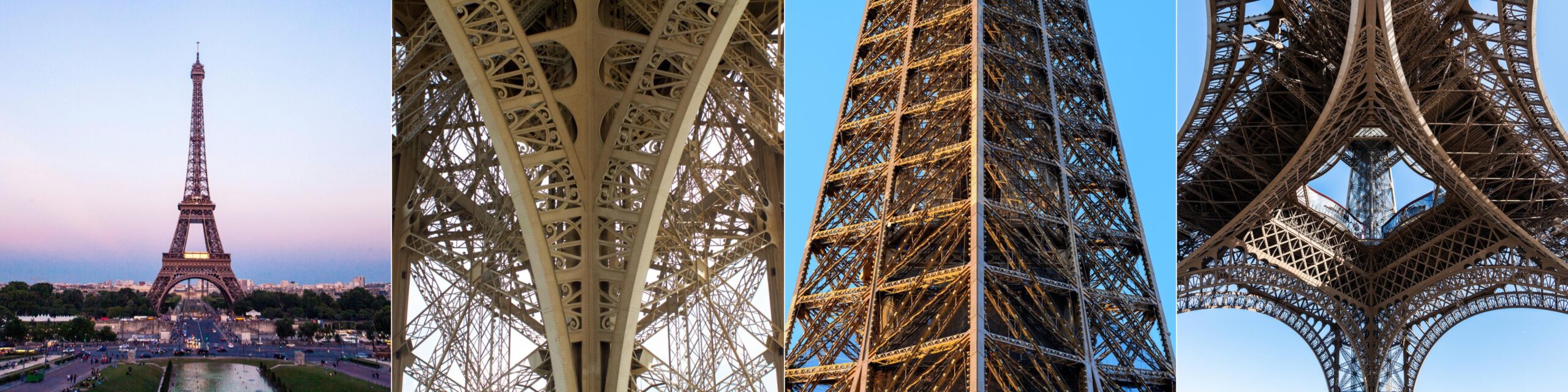
The Eiffel Tower is essentially a giant triangular lattice. Its diagonal bracing distributes wind loads efficiently, which is why it has stood strong since 1889.
2. Efficient Load Distribution in Modern Architecture
When architects talk about efficient structural systems, triangles are often doing the invisible work. In long-span roofs, stadiums, airports, and high-rise buildings, triangular configurations allow greater strength with less material, reduced deflection under load and better performance under dynamic forces (like wind or earthquakes).
This is especially important in sustainable architecture, where reducing material usage directly impacts cost and carbon footprint.
Real-world example:
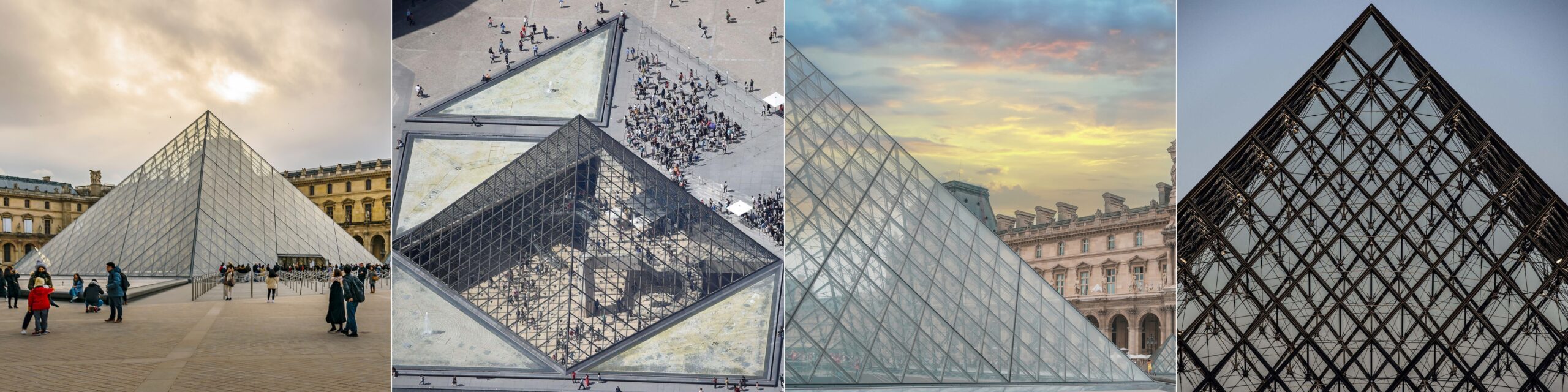
The Louvre Pyramid is composed entirely of triangular glass panels. The geometry ensures structural integrity while maintaining transparency, blending engineering precision with architectural elegance.
3. Triangles in Everyday Architecture: Roofs, Facades, and Structural Frames
Triangles aren’t limited to landmark projects or iconic towers. They show up quietly in everyday architecture, residential homes, commercial buildings, schools, and mixed-use developments. Look at a typical pitched roof. The classic gable form is essentially two triangles meeting at a ridge. Why has this geometry persisted for centuries? Because it works.
A triangular roof form:
- Distributes loads efficiently toward load-bearing walls
- Allows for effective rainwater and snow drainage
- Reduces bending stress compared to flat spans
- Simplifies structural framing
Real-world example:
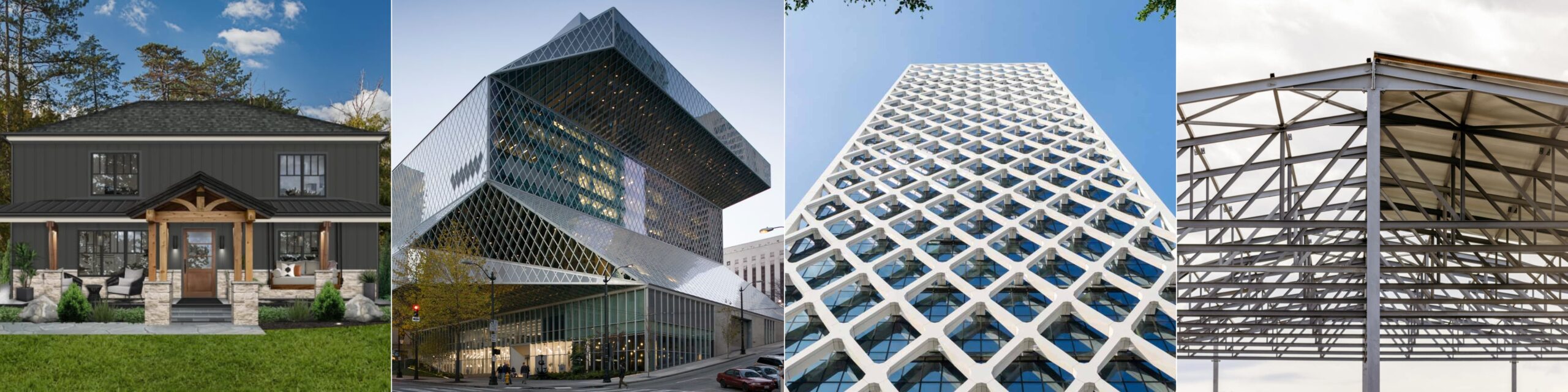
In commercial and industrial buildings, triangular roof trusses and diagonal bracing systems are standard practice. They increase rigidity without significantly increasing material use.
4. Triangles in Contemporary and Parametric Architecture
With the rise of parametric design software, BIM workflows, and computational architecture, triangular meshes have become even more relevant. Digital modeling platforms often break complex curved surfaces into triangulated panels because:
- Triangles adapt easily to irregular forms
- They simplify fabrication logic
- They improve structural rationalization
From museum facades to cultural centers, triangulation allows architects to translate organic concepts into buildable systems. The triangle isn’t just a legacy of traditional engineering, it’s foundational to digital architecture.
5. The Psychology of Triangular Forms
There’s also a subtle psychological dimension.
Triangles can feel:
- Directional (pointing upward = aspiration)
- Stable (wide base forms)
- Dynamic (angular compositions)
In architectural space planning and design language, these geometric cues influence how users perceive a structure, whether it feels grounded, dramatic, or progressive. This matters in commercial architecture, cultural institutions, and landmark buildings where perception is part of performance.
So, Why Do Architects Keep Returning to Triangles?
Because triangles solve problems.
Structurally, triangles provide inherent stability and efficient load distribution, making buildings stronger with less material. Geometrically, they enable complex forms, support parametric design systems, and translate ambitious concepts into buildable solutions. Visually, they introduce movement, direction, and clarity into architectural compositions.
In a profession that constantly balances aesthetics, engineering, and sustainability, the triangle remains one of the most reliable tools in architectural design, not because it is simple, but because it consistently performs.
Enjoyed this post?
Explore more resources here or book a quick call to learn how MGS Global Group can support your drafting and construction documentation needs.