AI Slop Is a Reputation Risk for Architecture: Here's Why It Should Be on Your Radar
- 4 min read
- May 4, 2026

Most architects aren’t losing clients because their design work is weak. They’re losing ground, in search results, in proposal rooms, in client conversations, because of something far less visible: the quality of the content representing their firm.
That project description that sounds polished but says nothing. The design narrative that uses “innovative” and “sustainable” four times in two sentences. The spec section that’s technically accurate but feels like it was written by someone who has never touched a set of drawings.
That’s AI slop. AI slop directly affects how clients perceive your expertise, how Google ranks your website, and how your team communicates design thinking. The real question was never whether to use AI. It’s whether what you’re putting out actually represents your firm at the standard it deserves.
What Is AI Slop?
“AI slop” is a term that’s gained traction across creative and professional industries to describe low-quality, mass-generated AI content that lacks substance, specificity, or genuine insight. It’s content that technically exists, technically answers a question, but adds no real value.
In architecture, AI slop often appears as:
- Generic design narratives that reference “human-centric design” without explaining how a specific building achieves it
- Overuse of buzzwords like “innovative,” “dynamic,” or “cutting-edge”
- Technical writing that uses correct terminology but lacks the precision that comes from actual field experience
- Thought leadership content that sounds authoritative but is essentially a reshuffling of widely available information
The core problem with AI slop isn’t that it’s inaccurate. It’s that it’s interchangeable, and in a profession where differentiation is everything, interchangeable is deadly.
Why This Actually Matters for Your Firm
1. Clients notice, even if they can’t name it
Clients may not know the term “AI slop,” but they feel it. A proposal that reads like it could belong to any firm signals that your team didn’t engage deeply with their brief. Architecture is a high-trust purchase, and vague, generic content undermines that trust before a conversation even begins.
2. It damages your search rankings
Google’s Helpful Content updates penalise thin, generic, AI-generated content. If your website is populated with slop, blog posts and service pages that could apply to anyone, you’re not just failing to attract traffic, you’re actively being ranked lower. For firms that rely on their website to generate enquiries, this is a direct business problem.
3. AI-Generated visuals can misrepresent your actual capability

This is where architecture is uniquely exposed compared to other industries. AI image tools like Midjourney, Stable Diffusion, and Firefly can produce visuals that look extraordinary at first glance, but they have no understanding of how buildings actually work. The tell-tale signs are there for anyone who looks: columns that float, staircases leading nowhere, structural elements that defy gravity, materials with textures that don’t correspond to anything real, floor plans that are spatially impossible. In videos, inconsistent lighting, surfaces that morph between frames, and distorted human figures are the giveaways.
The real danger isn’t that these visuals look bad, it’s that they can look impressive while being structurally incoherent. When used in portfolios, proposals, or marketing content without any disclosure, they create a gap between perceived and actual capability. Clients who later see the real drawings, or the built work, notice that gap. In a profession built on technical credibility, that’s a hard thing to recover from.
4. It quietly deskills your team
Proposal writing and design narrative aren’t just content tasks, they’re forms of architectural thinking. When those are handed entirely to unedited AI output, the team loses the habit of articulating design decisions with precision. That habit is part of what makes a firm credible, and it’s not easily rebuilt once it’s gone.
Solutions: How to Use AI Well Without Producing Slop
None of this means stopping the use of AI. The firms navigating this best aren’t avoiding AI, they’re using it with intent, editing with standards, and being transparent about the process. Here’s how that looks in practice.
- Use AI as a starting structure, not a finished product. AI is genuinely useful for getting a rough draft on paper when you’re staring at a blank page. But that draft needs to be treated as a skeleton, not a deliverable. Every section should be interrogated: What’s the actual point here? What specific detail makes this true for our project?
- Build a library of real firm language. Your best proposal paragraphs, your strongest project narratives, your most precise technical descriptions, archive them. Use them as prompting material for AI and as a quality benchmark when editing output. The better the input, the better the output.
- Use AI visuals as inspiration, not portfolio work. AI image and video generation tools are genuinely useful for moodboarding, exploring massing options quickly, or communicating a concept direction in early stages. That’s a legitimate and efficient use of the technology. Where it becomes slop is when unedited AI renders get published as representative design work, or passed off as actual project imagery. The fix isn’t to stop using these tools, it’s to be clear about what the image is, what stage of the process it represents, and whether it reflects real design decisions your team actually made.
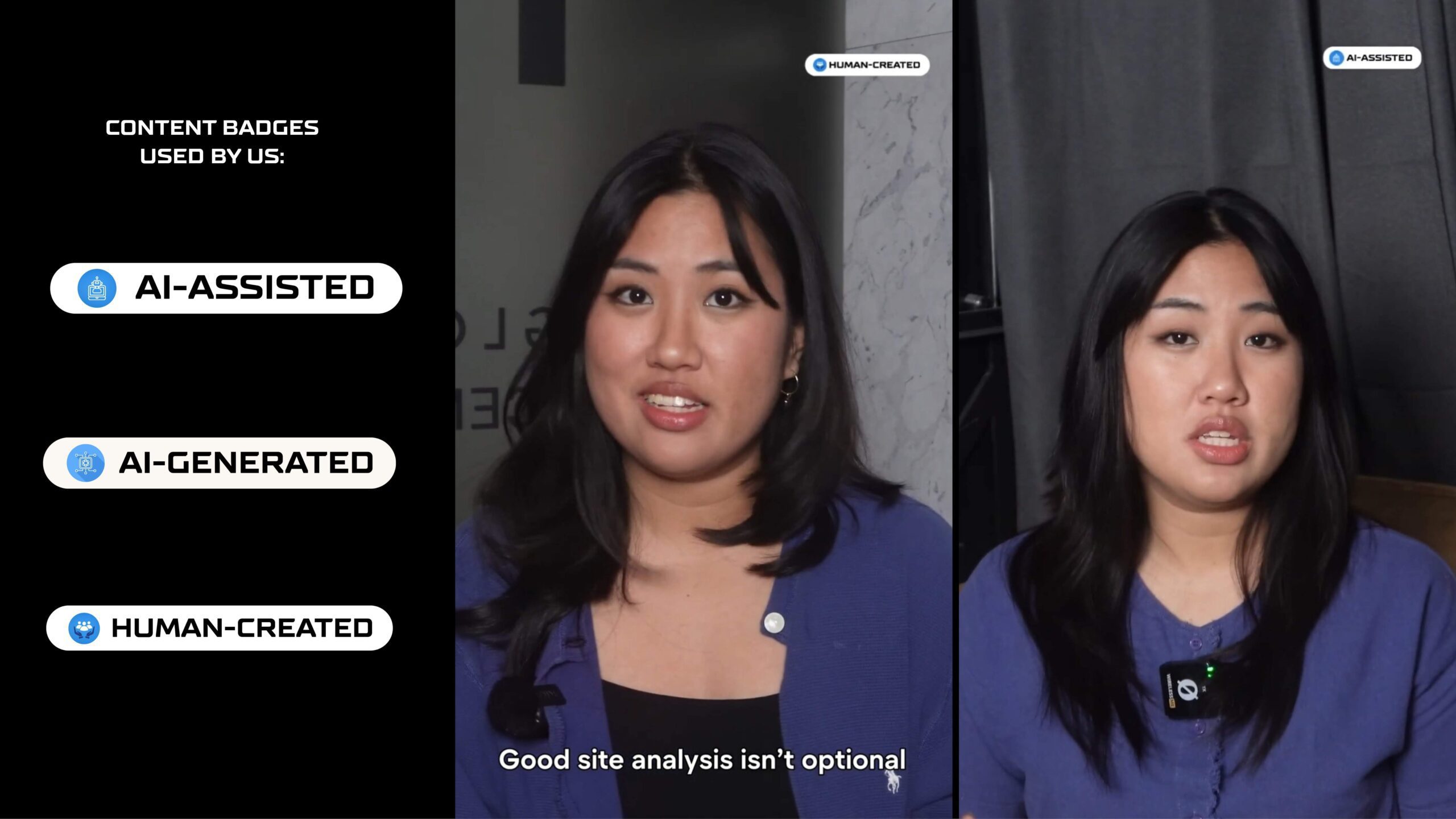
- Be transparent about how your content is made. This is something we’ve started doing last year at MGS, using content badges to distinguish between human-written and AI-assisted content. It sounds like a small thing, but it matters more than most firms realise. Transparency builds trust. It signals to your audience that you’re not trying to pass off generic output as original thought, and it raises the bar internally, when you label something as human-written, you hold it to a higher standard. More firms in the AEC space should be doing this.
Final Thoughts
AI slop isn’t an AI problem, it’s an accountability problem. The tool isn’t the issue; it’s what gets published without enough human judgment behind it.
The architecture profession demands precision, specificity, and the kind of contextual thinking that comes from years on real projects. Your content should reflect that, and AI can absolutely help you get there faster, as long as someone with real expertise is steering it.
Because in the end, architecture is not just about what you design, it’s about how you communicate your thinking.
And no tool can replace that.
Enjoyed this post? Give a thumbs up or leave a comment!
Explore more resources here or book a quick strategy call to learn how MGS Global Group can support your drafting needs.